
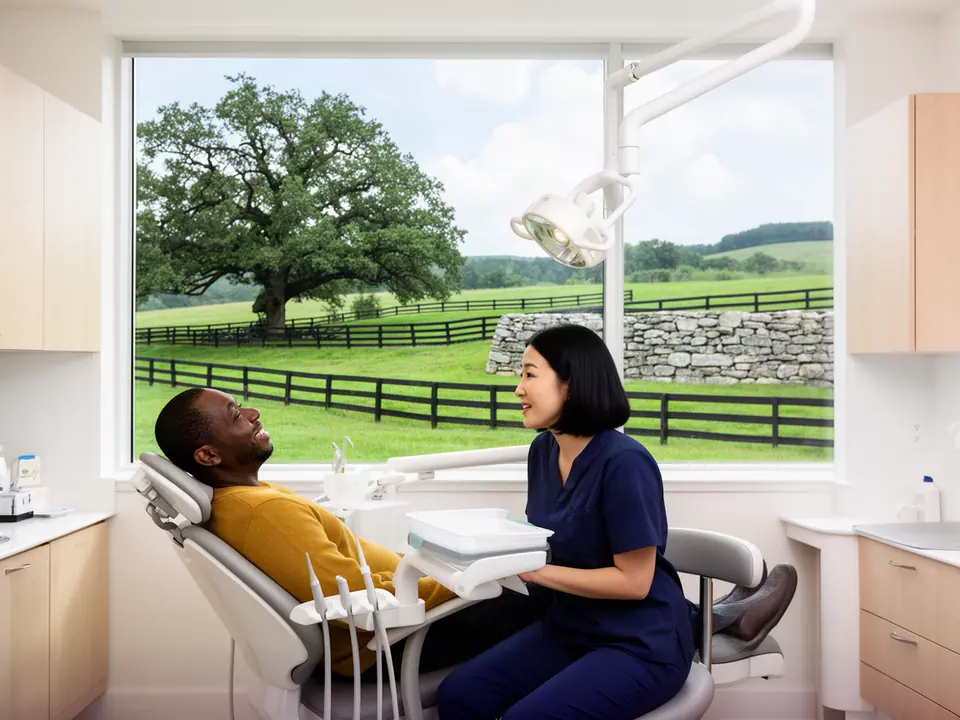
Dental practice loans in Lexington, KY help dentists finance chairs, imaging and practice technology, build out or expand an office, and manage the timing between insurance and patient payments. Lodgeleaf Business Loans arranges equipment financing, term loans and working capital for dental practices through funding partners, who make every credit decision.
| Dentist practices carrying a payroll in Fayette County, KY | 167 on the 2023 CBP employer tally |
|---|---|
| Paid employees | 1,166, with about $73.4 million in annual payroll (CBP 2023) |
| Dentist offices in ZIP 40508 | ZBP 2023 tally: 9 |
How a dental practice's cash cycle works
Dental revenue arrives through three channels: patient payments at the visit, insurance claims paid later, and treatment plans paid over time. Costs are heavy and front-loaded: equipment, lab fees for crowns and appliances, supplies, and a staff of hygienists and assistants. Expanding by one operatory means buying a full room of equipment before it books a single appointment.
Fayette County, KY dental offices in the Census tables
County Business Patterns 2023 counted 167 offices of dentists (NAICS 6212) with employees in Fayette County, KY in 2023. They employed 1,166 people with an annual payroll of about $73.4 million. Fewer than five employees worked in 66 of them (39.5%), a smaller share than the 47.7% for the county's health care and social assistance sector as a whole. Downtown ZIP 40508 had 9 dental offices.
The Nonemployer Statistics 2024 program counted 52 dental offices with no employees in 2024, a separate program and year, not added to the employer count.
Chairs, imaging and scanners: dental equipment financing
- Chairs, delivery units and operatory lights
- Digital radiography, panoramic and cone-beam imaging
- Intraoral scanners and in-office milling
- Sterilization and compressor or vacuum systems
- Practice-management and imaging software, if bundled with hardware
Equipment usually secures the financing. Partners look at the vendor quote, and for used or refurbished items the age and service record. See equipment financing for lease versus purchase.
Dental office loans for build-outs and second locations
A business loan for a dental office build-out pays for plumbing, electrical, cabinetry and the operatories themselves. Dental build-outs add plumbing, compressed air and vacuum lines, which add to the budget and to permitting. A term loan carries the space; equipment financing carries the chairs and imaging. A dental clinic opening a second site usually needs both.
One more operatory, worked by hand
Hypothetical figures only: equipping one operatory costs $70,000, and suppose the payment came to $1,400 a month (a placeholder, not a quote). If the room adds six hygiene visits a day at $60 of margin each, that is $360 a day, so the payment is covered in four working days a month. Run your own figures with the loan payment calculator for the payment; the visit math is done by hand.
Upgrading technology versus replacing worn equipment
Partners read two kinds of dental equipment request differently. Replacing a failing compressor or a worn chair keeps the practice running and is judged against current cash flow. Adding new technology, such as an intraoral scanner, in-office milling or cone-beam imaging, is judged partly on what it adds: fewer lab fees, procedures kept in-house, shorter treatment times.
For an upgrade, write down what the equipment changes in the practice's numbers. For a replacement, note the age of what it replaces. Either note takes two minutes and makes the request easier to review.
Dental office working capital loans
A dental office working capital loan covers payroll and lab bills while insurance claims are outstanding, or the first months of a new associate's salary before their schedule fills. For recurring gaps, a line of credit usually fits better. The working capital page goes further.
Hygienists, assistants and the average dental payroll
Our arithmetic on County Business Patterns 2023: 1,166 employees across 167 dental offices is about seven people per office, and $73.4 million in payroll over those employees comes to roughly $62,900 each, part-time workers included. Those are plain averages, not wages. A practice of that size that adds a hygienist adds about a seventh to its headcount before the new hygiene schedule fills.
The 52 dental offices without employees in Nonemployer Statistics 2024 reported about $4.3 million in receipts. That program is separate and is not added to the employer figures.
Business loans for a dental practice: the paperwork
- Vendor quotes for chairs, imaging or scanners, with installation and training on separate lines
- The contractor's estimate for a build-out, plus the lease or purchase agreement for the space
- Recent practice bank statements
- Collections by payer type, and an insurance aging report
- Existing equipment leases and loans, with their remaining terms
For a dental clinic adding a second site, a short note on how the two locations will share hygienists, front-desk work and lab orders makes the budget easier to follow.
Matching dental needs to funding
| Need | Funding shape |
|---|---|
| Operatory chairs, imaging, intraoral scanners | Equipment financing |
| Build-out, relocation, second office | Term loan |
| Payroll and lab bills during claim processing | Working capital |
Partners typically review bank statements, collections by payer type, existing equipment leases, and the quote or build-out budget. Patient financing for dental treatment is outside what Lodgeleaf handles; this page is about the practice as a business.
Other health practices in Lexington, KY
Physician offices, chiropractic and therapy practices and pharmacies have their own pages under funding by industry. The countywide Census tables sit on the Lexington, KY page.
By Lodgeleaf Business Loans · Updated